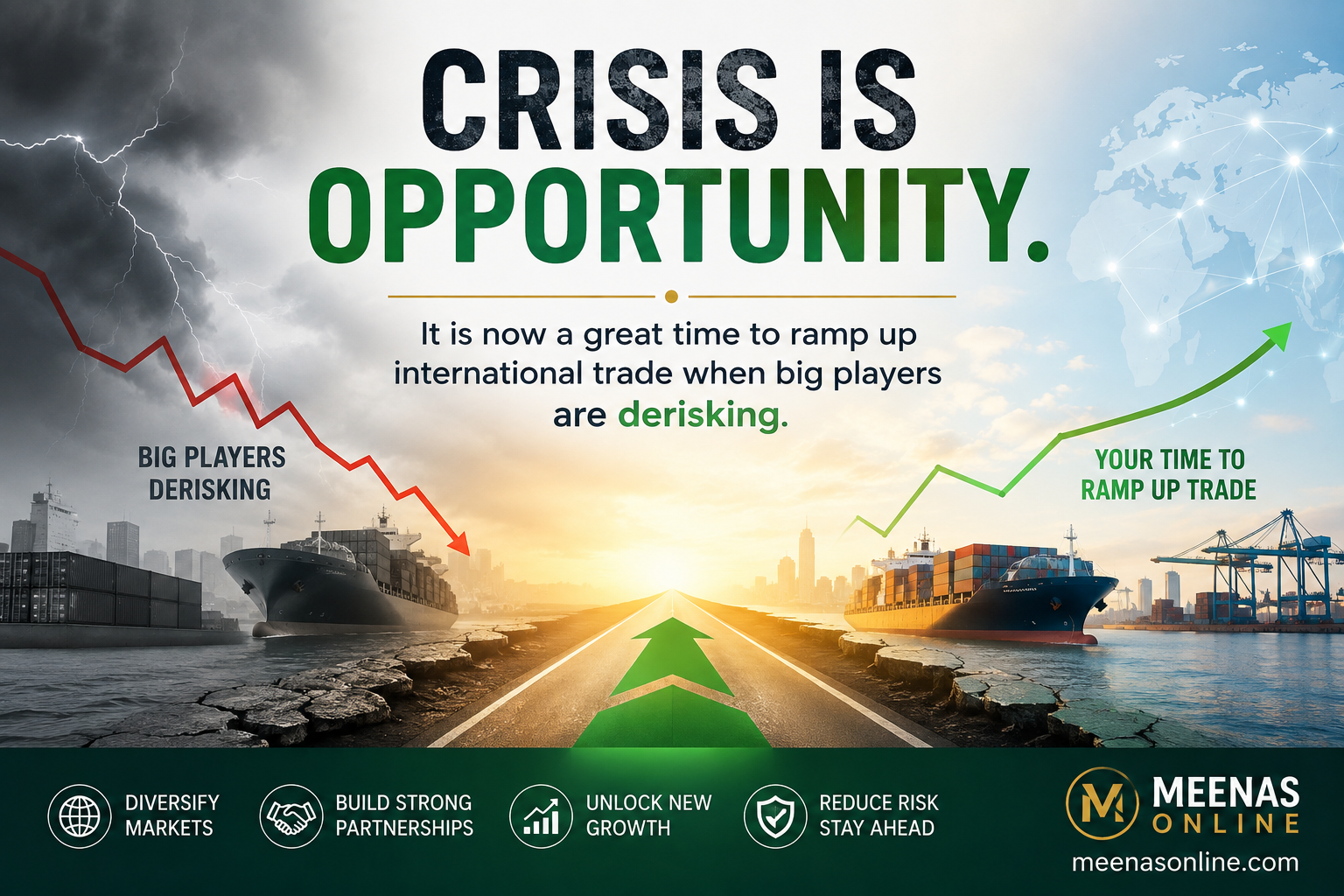
Every era of global uncertainty produces the same split screen. On one side, the large incumbents pull back, tighten, and wait. On the other, a smaller group of agile businesses reads the same headlines and sees something different: open space. Right now, as multinationals aggressively “derisk” their supply chains and retreat from markets they once crowded, that open space is wider than it has been in years — and for anyone serious about international trade, it is exactly the moment to lean in and ramp up.
The great derisking is real — and it is reshaping trade
“Derisking” has moved from boardroom buzzword to operating strategy. Under the banners of China+1, multi-sourcing, and what analysts now call “China Shock 2.0,” the world’s largest companies are deliberately spreading their supplier base, reshoring sensitive production, and exiting markets they judge too volatile to manage from a distance. The intent is defensive: reduce concentration, hedge geopolitical exposure, and protect margins.
But every defensive retreat leaves something behind. When a giant multinational trims a product line, drops a distributor, or walks away from a promising-but-complicated market, the underlying demand does not disappear. Customers still need suppliers. Ports still need cargo. Distributors still need partners. The question is simply who steps in.
Why the giants pulling back is your opening
Large players derisk precisely because they are large. Their scale makes complex, emerging, or fast-moving markets expensive to serve and slow to navigate. That is a structural disadvantage — and a structural advantage for businesses that are closer to the ground, faster to decide, and willing to build real local relationships. What looks like “too much risk” from a headquarters ten time zones away often looks like “a warm introduction and a signed contract” from someone with people on the ground.
This is the heart of “crisis is opportunity.” The moment the market feels most uncertain is the moment competition thins out, suppliers become more flexible, partners become more open, and first-mover advantage is cheapest to acquire. Four moves define the businesses that win this window:
- Diversify markets — reduce dependence on any single country or customer by opening new corridors before you are forced to.
- Build strong partnerships — lock in local distributors, agents, and suppliers now, while they are actively looking for reliable counterparts.
- Unlock new growth — capture the demand that retreating incumbents leave on the table.
- Reduce risk and stay ahead — a spread of markets and partners is itself the best hedge against the next shock.
Where the international trade opportunity is concentrated
The clearest openings are in high-growth, under-served corridors where global players hesitate but demand is climbing. Across Iraq, Pakistan, Saudi Arabia, Qatar, and the UAE, infrastructure spending, industrial diversification, and rising consumer demand are creating exactly the conditions where a well-prepared entrant can establish itself quickly. The Gulf is investing heavily in becoming a manufacturing and logistics hub; Iraq and Pakistan represent large, young, import-dependent markets that reward suppliers who show up with the right local structure. These are not markets you enter from a spreadsheet — they are markets you enter with a partner who knows the ground, the regulation, and the people.
How to move now — without trading recklessly
“Crisis is opportunity” is not a call to be reckless. It is a call to move deliberately while others freeze. A disciplined entry sequence looks like this:
- Pick the corridor, not just the country. Decide which trade lane fits your product, margins, and logistics before you fall in love with a single market.
- Validate demand and regulation early. Understand tariffs, certifications, and compliance requirements up front — this is where most entrants stall.
- Secure a local partner before you scale. A trusted on-the-ground partner turns a risky market into a managed one.
- Start focused, then expand. Prove one lane, build the relationships, and use that credibility to open the next.
- Treat risk as something to manage, not avoid. The businesses that win are not the ones who took no risk — they are the ones who structured it well.
The window will not stay open forever
Derisking is a moment in time. The space that today’s caution creates will eventually be filled — by competitors who read the same signals and moved. The advantage belongs to those who act while the lane is still open and the partners are still available.
This is exactly the moment Meena Business Consultancy is built for. As a cross-border partner with on-the-ground expertise across Iraq, Pakistan, Saudi Arabia, Qatar, and the UAE, we help you identify the right corridor, navigate regulation and compliance, and connect with vetted local partners — so you can turn today’s uncertainty into tomorrow’s market position. Talk to us about your market-entry strategy and let’s map your move while the window is open.