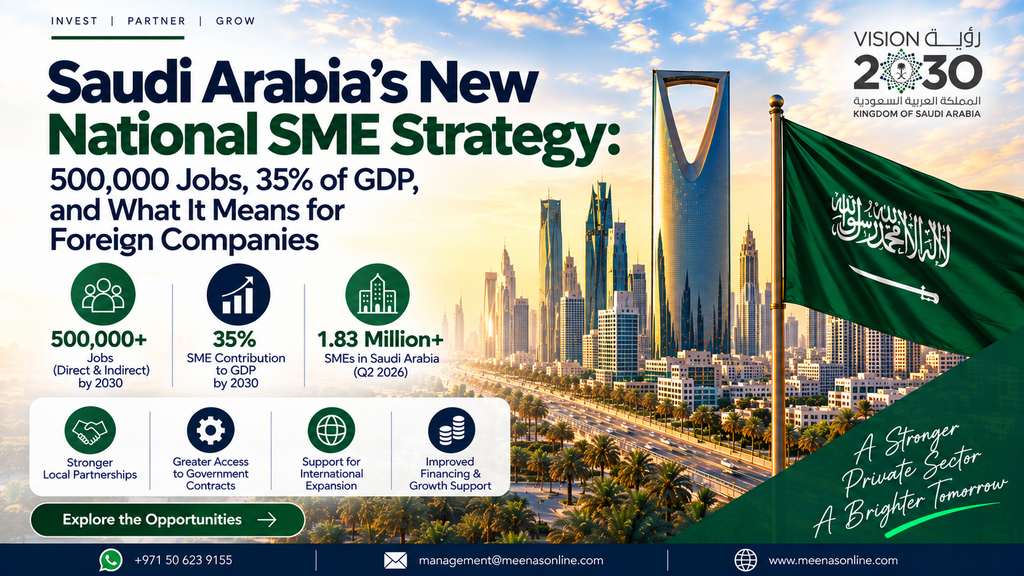
Saudi Arabia’s Cabinet, meeting in Jeddah under Crown Prince and Prime Minister Mohammed bin Salman, approved a new National Strategy for Entrepreneurship and Small and Medium Enterprises this week. Minister of Commerce Dr. Majid bin Abdullah Al-Kassabi, who also chairs the SME General Authority (Monsha’at), presented the strategy and thanked King Salman and the Crown Prince for the approval, a signal of how central this initiative is considered within the broader Vision 2030 framework.
The headline targets are ambitious: raise the SME sector’s contribution to GDP to 35%, and create more than 500,000 direct and indirect jobs by 2030. But the more important story sits beneath those numbers, in what the strategy actually changes about how Saudi Arabia treats small and medium enterprises, and what that shift means for foreign companies looking to plug into the Kingdom’s private sector.
Why this matters more than a typical policy announcement
Saudi Arabia already has a large SME base to build on. The number of SMEs in the Kingdom exceeded 1.83 million by the end of the second quarter of 2026, according to Monsha’at Deputy Governor for Entrepreneurship Saud Al-Subhan. What’s changing isn’t the size of that base, it’s the government’s stated priority for it. Officials described the strategy as marking a shift from focusing on business creation toward building the enablers needed for growth, expansion, and international competitiveness.
That distinction matters. A strategy focused on registering new businesses produces a large number of small, often fragile companies. A strategy focused on scaling and competitiveness produces companies that can absorb larger contracts, enter export markets, and integrate into supply chains, a different opportunity for a foreign company looking for capable local partners.
What the strategy actually contains
The strategy is built around seven pillars, translated into 13 focused programs. Between the various official summaries, the specifics include:
- Open commercial innovation platforms and dedicated support for SMEs and startups operating inside industrial cities and special economic zones
- Deeper integration of SMEs into government procurement and the supply chains of major enterprises, giving smaller companies a real path into large-scale contracts rather than competing only for smaller work
- Support for international expansion, including programs specifically aimed at helping Saudi SMEs increase exports and enter new international markets
- Attracting and localizing innovative international startups, an explicit signal that foreign entrepreneurial talent and technology are seen as part of the solution, not just domestic capacity building
- Review of minimum Saudization requirements by sector, rather than a flat one-size-fits-all rule
- Financing reform, including improved financial literacy programs and incentives for financial institutions to lend to SMEs on better terms
- A comprehensive, linked SME database, connecting entrepreneurs to both local and global commercial opportunities
Alongside the strategy announcement, Monsha’at also confirmed that its Estrdad fee-refund initiative has already returned more than SAR 255 million to over 8,800 eligible SMEs, covering costs like commercial registration, licensing, chamber subscriptions, and some expatriate worker levies, with roughly 38,000 businesses provisionally meeting eligibility. The Business Weeks initiative also reported nearly 12,700 participants in the first half of 2026 alone, across 240 organizations and 218 networking events. These aren’t abstract policy promises. They’re programs already running at meaningful scale, which is a useful signal that the new strategy is building on active infrastructure rather than starting from zero.
What this means for foreign companies and investors
For a foreign company evaluating Saudi Arabia, this strategy touches three areas worth paying close attention to.
Partnership quality is likely to improve. A push toward SME integration into major-enterprise supply chains and government procurement means the pool of capable, growth-oriented Saudi partners is set to expand, not just in number, but in the kind of company each one is. A foreign business looking for a local partner able to handle real volume, rather than a small operation limited to modest contracts, has a genuine reason to look again at the SME segment specifically.
Sector-specific Saudization flexibility is worth tracking closely. A move away from flat Saudization quotas toward sector-by-sector rules could materially change workforce planning for foreign companies operating through SME partners or subsidiaries, depending on which sectors see rules eased or tightened.
The door is explicitly open to foreign entrepreneurial talent. The strategy’s stated intent to attract and localize innovative international startups is a direct signal, not a side effect. Companies with scalable, innovative business models may find Saudi Arabia positioning itself as a more active recruiter of exactly that kind of business than in previous years.
The bigger pattern
This SME strategy doesn’t exist in isolation. It’s one more piece of a broader pattern we’ve tracked in other Vision 2030-adjacent Cabinet decisions this year: the same September Cabinet meeting also approved the Ministry of Investment’s authorization to negotiate a foreign direct investment memorandum with Ireland, a headquarters agreement with the Institute of Internal Auditors, and cooperation agreements with Kazakhstan and Kuwait. Saudi Arabia is building institutional infrastructure, on the SME side and the foreign investment side, at the same time and through the same government machinery.
For a foreign company, that overlap is useful information. A country actively restructuring how it supports its own private sector, while simultaneously courting foreign capital and international partnerships, is a country signaling that it wants those two groups working together, not operating in separate lanes.
How Meena helps you act on this
Identifying the right Saudi SME partner, one aligned with this strategy’s growth priorities rather than a small operation with limited capacity, takes local market knowledge that isn’t visible from a press release.
- Market Entry Services covering the full entry process into Saudi Arabia, market entry strategy, regulatory guidance, and hands-on support structuring your presence.
- Market Analysis Services to identify Saudi SMEs and sectors aligned with your business, using the strategy’s own priority areas (industrial cities, special economic zones, export-oriented growth) as a filter.
- Business partner search and Meenas Circle to connect you directly with vetted Saudi SME partners rather than starting from a cold search.
- Market due diligence-style groundwork to assess partnership fit, sector-specific Saudization requirements, and regulatory considerations before you commit.
With operations across the UAE, Saudi Arabia, Qatar, Iraq, Pakistan, and the EU, Meena is positioned to help you find the Saudi partners this strategy is specifically designed to create, rather than defaulting to whichever company happens to answer first.
Meena Business Consultancy Services is a cross-border market-entry consultancy headquartered in Ajman Free Zone, UAE, operating across the UAE, Saudi Arabia, Qatar, Iraq, Pakistan, and the EU, with a strategic presence in Germany. Get in touch to discuss your Saudi Arabia market entry strategy.