
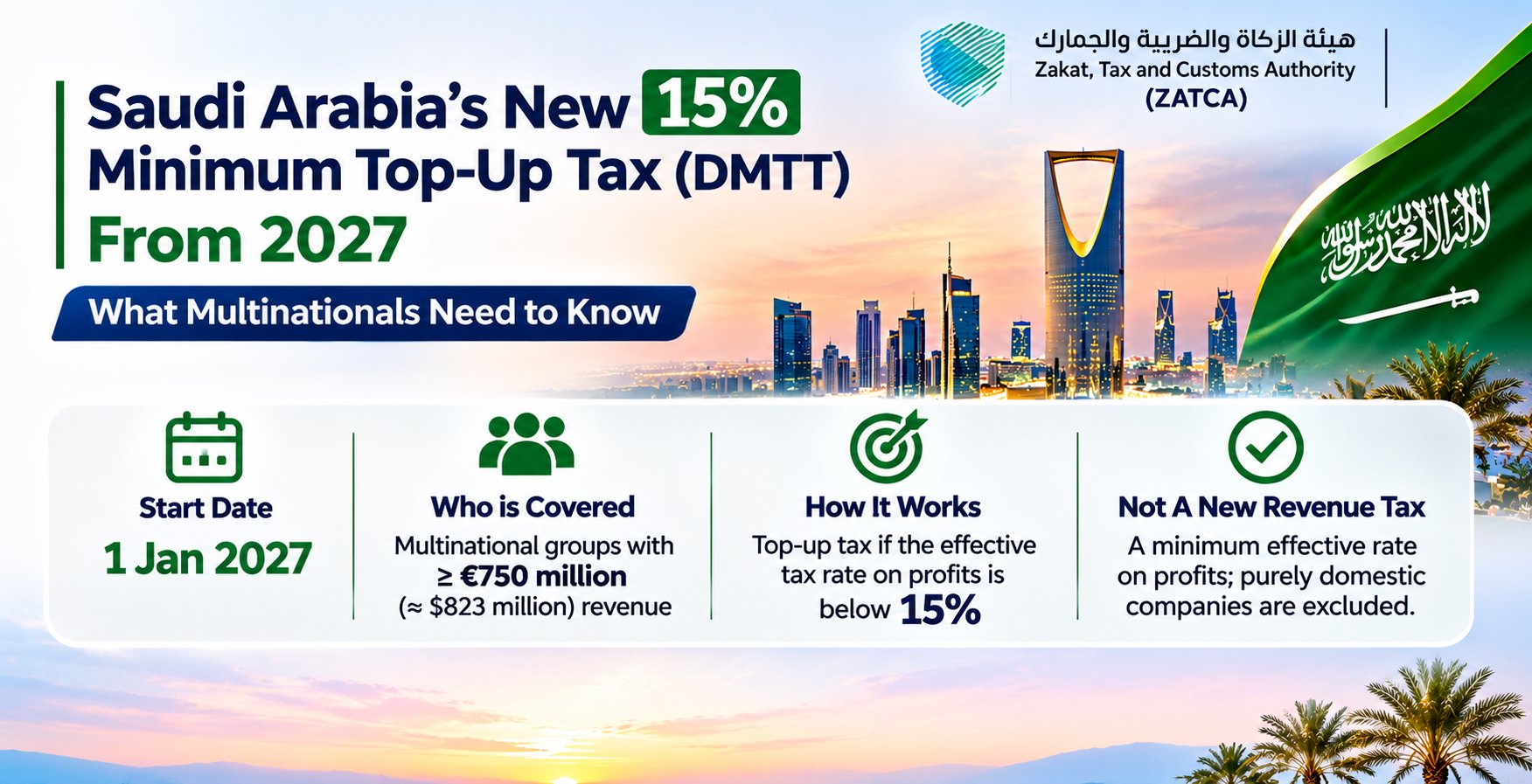
On 19 November 2026, Saudi Arabia’s Zakat, Tax and Customs Authority (ZATCA) announced a Domestic Minimum Top-up Tax (DMTT) from 1 January 2027, bringing the Kingdom in line with the OECD and G20 Pillar Two global minimum tax framework. The 15% is not a tax on revenue and not a tax on every company. It is a floor on the effective tax rate that very large groups pay on their Saudi profits.
What ZATCA announced
- Start date: 1 January 2027.
- Who is covered: entities of multinational groups with consolidated annual revenue of at least €750 million, or the riyal equivalent (roughly $823 million, per Arabian Business). The test uses the ultimate parent’s consolidated financial statements and must be met in at least two of the four preceding fiscal years.
- What it does: Saudi Arabia collects a top-up tax when the group’s effective tax rate on profits falls below 15%.
- What it does not do: it is not a levy on total revenues, and purely domestic companies and groups below the threshold are excluded.
ZATCA said the step protects the Kingdom’s tax rights over profits generated within its jurisdiction and keeps its tax system in step with international developments.
How it works, and why
In a simplified example, a covered group’s Saudi entities earn SAR 100 million and pay SAR 9 million in tax, an effective rate of 9%. The six-point shortfall means a top-up of about SAR 6 million, for a total of SAR 15 million. A group already paying 15% or more owes nothing extra. The real calculation is more detailed: Pillar Two rules adjust the profit and tax figures that count and exclude some income based on payroll and tangible assets.
A domestic top-up tax keeps the revenue at home. Without it, another country, such as the parent’s home country, could collect the top-up on low-taxed Saudi profits instead. The UAE has applied its own domestic minimum top-up tax since 1 January 2025, so the largest groups will work under similar rules in both countries.
Who is affected
- Directly: Saudi entities of European, American, Asian or Gulf-owned groups that meet the €750 million test, especially where incentives, exemptions or special regimes pull the Saudi effective rate below 15%. Groups using programs such as the Regional Headquarters program should check how the DMTT interacts with them.
- Not affected: purely domestic Saudi companies and groups below the threshold, which includes most small and mid-sized businesses.
- Indirectly: SMEs that supply, partner with or are owned by large groups may see new data requests, contract changes or pricing discussions. Fast-growing mid-sized groups should track consolidated revenue against the threshold.
What large groups should do before 1 January 2027
- Confirm scope by testing consolidated revenue against the €750 million threshold.
- Model the 2027 effective tax rate for each Saudi entity, including incentives and exemptions.
- Check other jurisdictions. The parent’s home country may have its own Pillar Two rules, so coordinate with your tax advisers.
- Prepare consistent financial and tax data across entities.
- Watch for implementing rules. The announcement sets the headline framework, and ZATCA’s detailed guidance will decide how it works in practice.
For most companies entering the Kingdom, the DMTT is not a barrier. A European SME planning a Saudi entity still needs the right structure, correct setup, and compliant accounting, tax and payroll from day one.
How Meena helps
- Market-Entry Advisory to choose the right structure and entry route.
- Company Formation to set up your Saudi entity correctly.
- Accounting, Tax and Payroll to keep local compliance in order.
- Legal and Compliance for contracts, licences and regulatory requirements.
- Grants and Funds Consultation to check whether part of your entry costs can be funded.
- Meena services for Saudi Arabia for the full overview.
Talk to us about your Saudi plans
For group-level Pillar Two modelling, involve your own tax advisers. We can coordinate the local setup, accounting and compliance in Saudi Arabia around their advice. Book a consultation to discuss your Saudi plans and how the 2027 changes fit them.
This article is general information based on ZATCA’s announcement and is not tax or legal advice. Rules and guidance may change, so check your specific position with a qualified tax adviser.
Meena Business Consultancy Services is a cross-border market-entry consultancy headquartered in Ajman Free Zone, UAE, operating across the UAE, Saudi Arabia, Qatar, Iraq, Pakistan, and the EU, with a strategic presence in Germany.
Sources: ZATCA announcement on the Domestic Minimum Top-up Tax (19 November 2026); Saudi Gazette; Saudi Press Agency via Trade Arabia; Arabian Business.
Planning to do business in Saudi Arabia? See all Meena support on our Services for Saudi Arabia page.