
21 Deals in Two Days: What the Saudi-France Paris Summit Really Tells European Companies
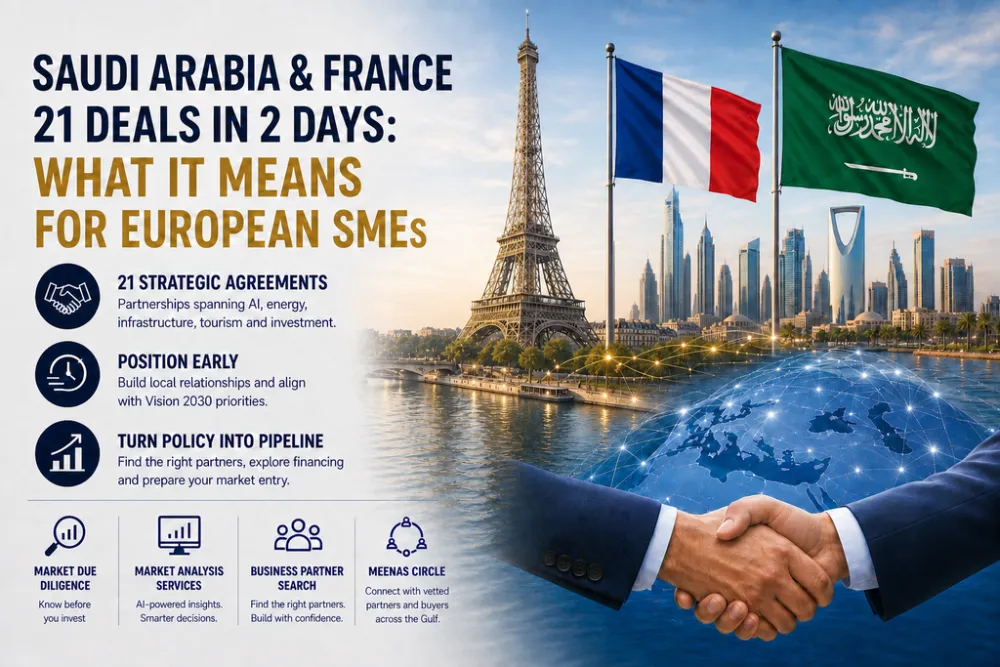
On 24 August 2026, Crown Prince Mohammed bin Salman and President Emmanuel Macron sat down at the Élysée Palace for the first meeting of the Saudi-French Strategic Partnership Council. By the end of the visit, the two countries had announced 21 agreements and memoranda of understanding spanning defense, artificial intelligence, entertainment, energy, transport, and culture.
Most coverage of the visit will list the deals and move on. The more useful question for a European company watching from outside is a different one: what does this summit reveal about how Saudi Arabia actually selects and rewards the partners it works with, and what would it take for your company to be in that position?
What was actually signed
The Council itself, established during Macron’s state visit to Riyadh in December 2024, met for the first time this week, and four agreements were exchanged directly between the two leaders. The existing Saudi-French agreement on AlUla was extended and amended through to 2035, expanding cooperation on culture, tourism, heritage, training, and sustainable development. A separate declaration of intent between the two countries’ defense ministries strengthened that partnership. A third agreement covered entertainment development, and a fourth, between Saudi Arabia’s Ministry of Communications and France’s Economy Ministry, set a framework for cooperation on artificial intelligence, quantum computing, and emerging technologies.
Beneath those sit the commercial deals that actually put capital to work. Saudi mining company Maaden signed a technology-development agreement with French nuclear group Orano. French AI company Mistral AI and Saudi-backed HUMAIN agreed a long-term framework covering computing capacity and joint AI model development. And Saudi Arabia committed roughly $7 billion to a Dragon Ball and manga-themed entertainment park near Paris, capital flowing from the Kingdom into Europe, not the other way round.
Then there’s the financing, which is the part most relevant to a mid-sized company weighing its own move. Bpifrance, France’s state export credit agency, is backing up to $3 billion for Saudi Arabia’s energy sector and roughly $5 billion for projects tied to Riyadh Metro, the Sharaan Hotel in AlUla, and rolling stock ahead of Expo 2030 and the 2034 World Cup.
Why the timing isn’t a coincidence
France and Saudi Arabia marked a century of diplomatic relations this year, and bilateral trade reached around €10.1 billion in 2025, up 7.2% year on year. That trajectory was already in motion well before this week. What sharpened it is a deadline: Expo 2030 in Riyadh and the 2034 World Cup are close enough now that metro systems, hotels, and infrastructure have to be financed and built on a fixed timeline, not an open-ended one. France has already confirmed its participation in Expo 2030, and both sides have said they intend to make it a centerpiece of the relationship going forward.
That’s a detail worth sitting with. This isn’t a partnership built around vague goodwill. It’s organized around milestones with fixed dates, which is exactly why it’s moving at the pace it is.
The pattern hiding inside the AlUla agreement
If you want to understand how Saudi Arabia actually rewards long-term commitment rather than a one-off signing, AlUla is the clearest example available.
Saudi Arabia and France agreed to develop AlUla together back in 2018. Since 2019, the Royal Commission for AlUla and its French counterpart agency have signed more than 170 contracts with French companies, together worth over $200 million. That work has produced real, embedded institutions: a joint Saudi-French cultural venue that launched in October 2025, a French research body advising on AlUla’s new contemporary art museum, an archaeology partnership with a Paris university running field schools and a master’s program, and Saudi and French designers collaborating directly on cultural projects.
None of that came out of a single trade mission. It came from an agreement signed eight years ago, followed by companies and institutions that showed up, delivered, and stayed. This week, that same agreement was extended for another decade, which is a fairly direct signal of how Saudi Arabia treats partners who’ve proven they’re in it for the long run.
What this actually means for a European SME
The lesson here isn’t really about France, or about the specific sectors named this week. It’s about how Saudi Arabia structures the decision of who gets to participate in Vision 2030, and that pattern holds regardless of which European country or company is involved.
Government-to-government frameworks come first, and commercial deals follow. The ministry-level AI and quantum computing agreement signed this week is the exact ground on which Mistral AI and HUMAIN then built their own commercial arrangement. A company that waits until the framework in its own sector is publicly announced is already behind the companies that positioned themselves while it was still being negotiated.
Export finance backing matters, and it isn’t unique to France. Bpifrance is de-risking French companies entering Saudi projects because the French government has decided this market is a priority. It’s worth checking what your own country’s export credit agency or development bank offers for Gulf market entry, since equivalent instruments exist for German, other European, and UK companies too.
Long-term presence is what actually gets rewarded. Eight years of sustained work in AlUla produced 170 contracts and a decade-long agreement renewal. Saudi institutions are quietly assessing whether a given company will still be operating there in ten years, and they form that judgment early, often well before any formal signing ceremony.
Being physically present outperforms simply expressing interest. Every French institution now embedded in AlUla has people on the ground in the Kingdom, not just a signed MOU on file. That’s the practical bar for what genuine participation in a Saudi partnership actually looks like.
Where this leaves a company that hasn’t started yet
Nothing signed in Paris this week began this week. Every one of those 21 agreements sits on top of years of relationship-building, structural groundwork, and prior delivery. That’s a real barrier to entry, but it’s also the opening for companies willing to do the same groundwork now, ahead of the agreements that will be signed in 2029 or 2032.
For a German or European SME evaluating Saudi Arabia, the practical starting points look like this:
- Identify which government-to-government framework covers your sector, and track it before it’s formally announced.
- Establish a physical or operational presence in the Kingdom rather than working entirely from abroad.
- Check what financing or export-credit support exists in your own country for Gulf market entry.
- Treat the relationship as a multi-year commitment from the outset. Saudi partners are watching for exactly that signal.
How Meena helps you act on this
This kind of market intelligence, reading which frameworks are moving, which sectors are being prioritized, and what a credible long-term presence actually requires, is exactly what a first-time entrant into Saudi Arabia needs and rarely has on their own.
- Market Due Diligence gives you the regulatory, licensing, and risk picture specific to Saudi Arabia before you commit capital or resources.
- Market Analysis Services use AI-driven comparison to identify where your sector fits against Saudi Arabia’s current priorities, and surface relevant potential partners already active in the market.
- Business partner search and Meena Circle, our B2B matching platform, connect you with vetted local partners and distributors, the kind of on-the-ground relationships that Saudi institutions consistently reward over remote engagement.
Meena is listed with the UK Department for Business and Trade, accredited by BAFA (Consultancy No. 225330), and listed in the Switzerland Global Enterprise Expert Directory, credentials that reflect the same long-term, credibility-first approach that governs how Saudi Arabia selects its own partners.
Meena Business Consultancy Services is a cross-border market-entry consultancy headquartered in Ajman Free Zone, UAE, operating across the UAE, Saudi Arabia, Qatar, Iraq, Pakistan, and the EU, with a strategic presence in Germany through our Network. Get in touch to discuss your Saudi Arabia market entry strategy.