
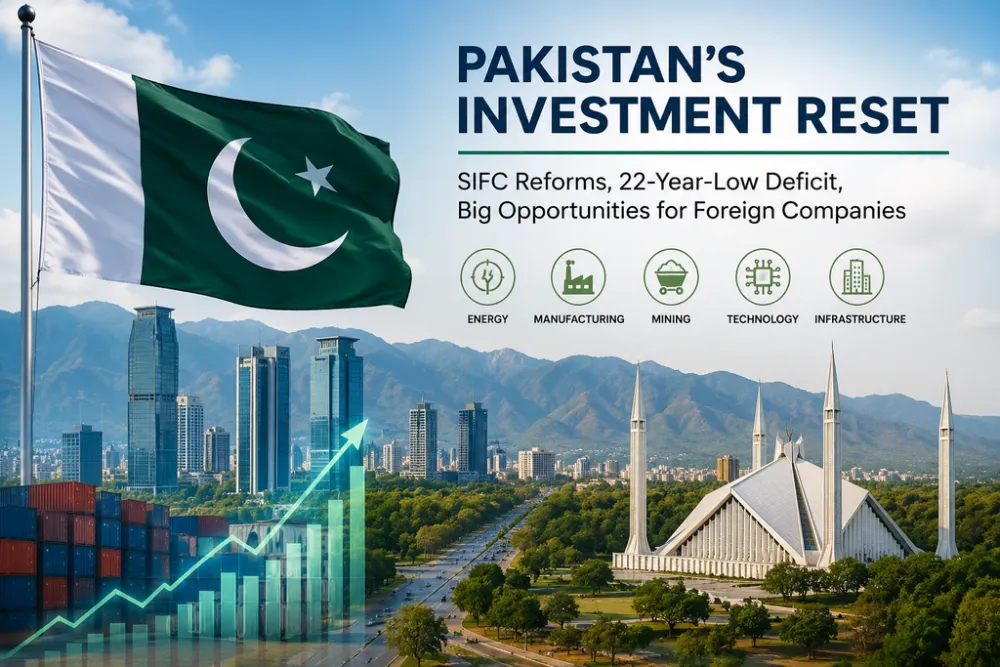
Pakistan’s Investment Reset: What the SIFC Reforms and a 22-Year-Low Deficit Mean for Foreign Companies Right Now
For years, Pakistan’s economy has been closely associated with IMF programs and financial instability. In 2026, that picture is beginning to change.
Pakistan’s fiscal deficit fell to a 22-year low of 2.6% of GDP in FY2025–26, while exports have started FY2026–27 with positive momentum. Challenges remain, particularly around public debt and the tax-to-GDP ratio, but the direction of travel is increasingly relevant to foreign investors.
The “Regulatory Guillotine”
One of the most important reforms is the government’s “regulatory guillotine,” being spearheaded through the Special Investment Facilitation Council (SIFC).
The initiative aims to remove outdated licenses, unnecessary paperwork, overlapping approvals, and redundant regulations that have historically increased the cost and time of doing business.
SIFC’s one-window approach is particularly significant because it is designed to improve coordination between ministries and government agencies, addressing one of the biggest weaknesses of previous reform efforts.
Early Signs of Progress
The reform agenda is already connected to specific investment activity, including:
- A $200 million mining project in Balochistan involving significant Barite-Lead-Zinc reserves.
- Financing for Challenge SEZ Lahore, supporting export-oriented manufacturing.
- New international business engagements involving energy, infrastructure, technology, manufacturing, and mining.
These developments suggest that investment facilitation is moving beyond announcements toward actual projects.
What It Means for European Companies
For European SMEs, Pakistan offers opportunities across technology, manufacturing, energy, infrastructure, agriculture, mining, and export-oriented industries.
Its large domestic market, young workforce, competitive cost base, and improving investment facilitation make it a market worth reassessing.
However, risks remain. Regulatory implementation can vary between federal and provincial authorities, and companies still need careful sector-specific due diligence before investing.
Why Meena Business Consultancy Services
Entering Pakistan is about more than registering a company with SECP. The real challenge is understanding the regulatory environment, identifying the right local partners, navigating sector-specific requirements, and turning an investment plan into an operating business.
Meena Business Consultancy Services helps international companies assess and enter Pakistan with local market intelligence and cross-border expertise.
Meena’s credentials include UK Department for Business and Trade listing, BAFA accreditation (Consultancy No. 225330), and inclusion in the Switzerland Global Enterprise Expert Directory.
Frequently Asked Questions
Is Pakistan’s economy improving?
Yes. The fiscal deficit reached a 22-year low of 2.6% of GDP in FY2025–26, although structural challenges remain.
What is SIFC?
The Special Investment Facilitation Council is a government coordination platform designed to accelerate investment and simplify business processes.
Which sectors offer opportunities?
Energy, infrastructure, technology, manufacturing, mining, and export-oriented industries are among the key areas attracting attention.
Should European companies consider Pakistan now?
Pakistan still carries execution and regulatory risks, but the improving fiscal position and investment reforms make it increasingly worth evaluating.Need help entering the Pakistani market?
Get in touch with Meena Business Consultancy Services to discuss your market-entry strategy.